

Understanding Corporate Bonds
Corporate bonds are a useful tool available to investors, but fully understanding them requires evaluating their underlying structure. This piece walks through corporate bond offerings, specificities of callable bonds, how rating agencies assess an issuer’s credit, what drive a bond’s price and yield, and the practical ways investors can gain exposure to this asset class. Together, these pieces provide important context needed to evaluate whether a corporate bond’s yield is fair compensation for its risk.
Corporate Bond Offering
When a company wants to fund new ventures or expand operations, it often relies on the corporate bond market, issuing bond offerings sized to the capital they need to raise. The offering itself represents the overall transaction, but what actually gets created and sold are thousands of individual bonds, each with identical terms within its tranche – a distinct slice of the offering. For example, $750 million of 5-year notes, $1 billion of 10-year notes, and $750 million of 30-year bonds priced and sold together on the same day (but in different tranches) could altogether compose a company’s $2.5 billion bond offering. Each tranche would have its own security identification code and pool of individual bonds underlying it.
Callable Corporate Bonds
All corporate bonds are categorized as short-term notes (with maturities of up to five years), medium-term notes (with maturities ranging between five and 12 years), or long-term bonds (with maturities greater than 12 years). Some corporate bonds carry an embedded call option, giving the issuer the right to redeem the bond after a redemption date. This structure favors the issuing company because there are many events that make early redemption advantageous.
- Rate cut—If rates were to drop, the rational decision would be to call and avoid overpaying old, high-rate bonds.
- Credit upgrade—An improvement in the issuer’s credit allows them to borrow in the market at a lower rate.
- Acquisition—In the event of an acquisition, the acquirer may prefer to retire old debt and consolidate everything under its own credit and capital structure.
- Consolidation—A company with multiple, different outstanding bond issues can improve administrative orderliness by calling smaller, older, or poorly structured issues.
The key idea is that the issuing company may call a bond whenever its benefit outweighs the cost of calling it. Moreover, since a callable bond is a legal compromise between two parties, it is often subject to multiple, different parameters. Some examples include:
- Call protection period (lockout period) —The initial timeframe during which the issuer is legally prohibited from calling the bond. For example, a 10-year bond might have a 5-year lockout period, meaning it cannot be called until the 5-year mark is reached.
- Call date(s) —The specified date(s) or schedule on which the issuer can execute the call. Typically, the range which the issuer can call spans from the first and only call date/the last day of the lockout period to maturity.
- Call price (or call premium) —The price the issuer must pay the bondholder if they redeem early. To compensate investors, this is often set at a premium above par value. The premium usually scales downward over time, eventually hitting par value closer to final maturity. Par value is the value at which the bond is to be redeemed at.
- Coupon premium—A callable bond frequently carries a higher coupon rate to an otherwise identical non-callable bond. This compensates the investors throughout the bond’s lifetime for the risk of being called.
- Notice period—The formal timeframe (typically 30 to 60 days) required for the issuer to publicly announce their intent to redeem the bond before the funds are actually disbursed.
In a callable bond transaction, the issuer wants maximum flexibility to act in its own interest, while the investor wants maximum predictability to protect their income. Issuers are under no legal obligation to include these parameters, but without them, investors would have little reason to buy callable corporate debt, since the terms of repayment would be entirely unpredictable.
While the call feature benefits the issuer, it introduces specific risks to the bondholder that don’t apply to standard, non-callable bonds. A few examples include:
- Reinvestment risk—Issuers tend to call when rates fall, which is exactly when reinvesting the returned principal at a comparable rate becomes difficult.
- Negative convexity—Once a bond becomes callable, or its first call date is approaching, price gains flatten and cap near the call price as rates drop, since rational investors won’t pay a meaningful premium above a price they expect the bond to be redeemed at soon. This creates an asymmetric outcome: the bondholder retains full downside if rates rise, but only limited upside if rates fall.
- Uncertain cash flow timing—Depending on the bond’s call date structure, investors may not know in advance whether the bond will be redeemed on the call date, sometime after the call date, or at full maturity. This makes it difficult to plan around specific future needs which may rely on scheduled income.
- Mispricing risk—A bondholder may overstate a callable bond’s return by relying on yield-to-maturity (YTM) alone, without also considering yield-to-call (YTC). YTM is the yield earned if the bond is held to maturity, while YTC is the yield earned if the bond is redeemed at a given call date. To conservatively estimate the bond’s actual expected return and account for call risk before committing capital, investors should evaluate yield-to-worst (YTW), which is the lowest of YTM and the yields to each possible call date.
Puttable Corporate Bonds
A puttable corporate bond has most of the same features as a callable bond, but the option belongs to the investor rather than the issuer. The investor has the right to sell the bond back to the issuer, usually at par, on one or multiple specific dates before maturity. In exchange for the protection, the investor accepts a lower coupon. For example, a 10-year bond that would normally yield 5% might pay closer to 4.8% if it can be put back in year 5.
The put protects the investor in two ways. First, if interest rates rise, they can exercise their put and reinvest at higher yields. Second, if the issuer’s credit weakens, they can get par back instead of selling at a steep discount.
However, the protection has its limits. Puts can usually only be exercised on set dates (as opposed to a range of dates), with notice due 30–60 days in advance. The credit protection only works if the put date arrives before the issuer encounters severe troubles. If an issuer defaults first, investors may not get par back. Because every holder has the same incentive to put when credit weakens, a wave of put can itself strain the issuer’s finances.
Rating Corporate Bonds
In the world of corporate bonds, there is a dividing line between investment-grade and speculative grade (high-yield) bonds, which separates higher credit quality issues from those carrying greater credit risk.
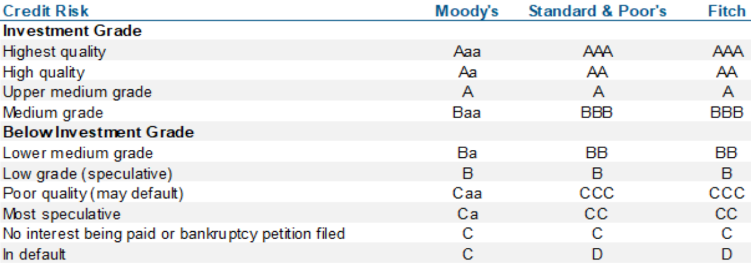
Grades are predominantly given by three rating agencies (Moody’s, Standard & Poor’s, and Fitch) based on the issuer’s perceived ability to pay back debt following a well-established process. The analysis begins by classifying companies according to the industry in which they operate, then characterizing that industry using criteria such as demand cyclicality, competitive intensity, capital intensity, and regulatory exposure. Agencies publish standardized industry risk assessments for major industries. For example, regulated utilities are classified as low risk, and homebuilding is classified as high risk. Next, the issuer’s position within that industry is evaluated based on specific parameters like scale and market share, diversification (by product, geography, and customer base), cost position relative to peers, and profitability. Then, the agency calculates the issuer’s core credit metrics, some of the most common being:
- Leverage—Debt relative to cash flow, with debt taken as a point-in-time balance sheet snapshot and cash flow represented as EBITDA, funds from operations (FFO) or free cash flow (FCF) measured on a trailing-twelve-month (TTM) basis.
- Coverage—Cash flow relative to interest and debt obligations. In this ratio, both cash flow (EBITDA, FFO, or FCF) and obligations are period-matched flow measures over the same window, typically TTM or fiscal year.
- Liquidity—Cash and available credit relative to near-term obligations. Unlike leverage and coverage, liquidity is assessed on a forward-looking basis usually spanning over the next 12 months.
Once the necessary qualitative and quantitative information is uncovered, a preliminary rating subject to adjustment is established. Factors like management track record, parent support (if the company is a subsidiary), or any other structural risks not captured in the core metrics are taken into consideration and may influence the preliminary outcome. Finally, the recommendation is brought to a rating committee of senior analysts, who review and vote on the final outcome. This is a deliberate control implemented to prevent any single analyst’s judgement from unilaterally determining a rating.
Pricing Corporate Bonds
Corporate bond prices are driven by interest rates, maturity, credit rating of the issuing company, and market sentiment. As with any bond, price and yield move inversely, but with corporates, yield reflects both the risk-free rate and the issuer’s credit quality.
Treasuries are priced primarily off interest rates. Rate cuts push prices up and yields down, while rate hikes push prices down and yields up. Corporate bonds adjust alongside Treasuries in the same way but typically yield a premium and carry a credit spread to compensate for credit risk.
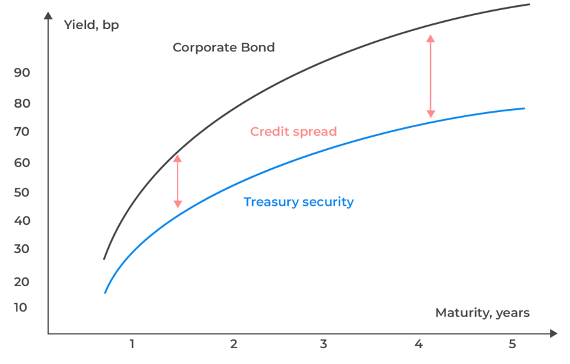
Illustrative purposes only
Longer-maturity bonds generally demand a higher yield, known as a term premium. This is compensation for locking up capital and taking on exposure to inflation, rate shifts, and other macro shocks for longer. Term premiums apply to any bond, including Treasuries.
Corporate bonds carry an additional, separate premium in the form of a credit spread. This compensates investors specifically for issuer default risk. The higher that default risk, the wider the spread, explaining why speculative-grade (high-yield) corporate bonds carry meaningfully higher yields than investment-grade bonds of the same maturity.
Investing in Corporate Bonds
Corporate bonds can help diversify many portfolios. The broad spectrum of corporates offers a wide range of risk and yield, allowing investors to tailor exposure to their individual circumstances, existing holdings, and risk appetite. Corporate bonds also have the potential to provide a steady stream of income, and most pay on a fixed semiannual schedule.
Investors can gain exposure to corporate fixed income through several routes, ranging from direct purchases of individual bonds to diversified vehicles like bond ETFs. Single bonds can be purchased and sold through a broker-dealer, either at the new issue (primary market, when the company issues the bonds) or on the secondary market from another holder. Buying single bonds can require significant capital to properly diversify, since building a portfolio across 20–30+ issuers at typical $1,000 minimums adds up quickly. Furthermore, corporate bond secondary market liquidity is relatively thin with wider bid-ask spreads. Despite these frictions, individual bonds also offer real advantages: a known maturity date (useful for laddering or matching future cash needs), a locked in yield if held to maturity, no ongoing management fees, and full control over issuer and credit exposure.
Bond ETFs (Exchange-Traded Funds) give investors the opportunity to hold a pooled basket of corporate bonds, enabling instant diversification across multiple issuers. These ETFs are typically defined according to the structural traits of their underlying assets, like duration, credit quality, currency, and geographic focus. For example, VCSH (Vanguard Short-Term Corporate Bond ETF) focuses on investment-grade bonds maturing within 1–5 years, SHYG (iShares 0–5 Year High Yield Corporate Bond ETF) tracks high-yield bonds that mature within 0–5 years, and SPLB (State Street SPDR Portfolio Long Term Corporate Bond ETF) holds long duration, investment grade bonds. These trade intraday on public exchanges with lower minimums (price of one share), higher liquidity, and transparent holdings information. Notably, bond ETFs mostly do not have a maturity date (unlike individual bonds), their market price may diverge from the underlying NAV (net asset value) in stressed markets, and they typically carry a management fee.
Final Words
Understanding how a bond is structured, rated, and priced gives investors the context to evaluate whether a given yield is fair compensation for the risk being taken, rather than judging a bond on its coupon alone. Whether accessed through individual bonds or diversified pooled investment exposure, corporate bonds remain a tool for investors seeking income, diversification, or a defined role within a broader fixed income allocation.
This material is intended for educational and informational purposes only. It is not intended to provide specific advice or recommendations for any individual. Additionally, you should consult with your Financial Advisor, Tax Advisor, or Attorney on your specific situation. The views expressed in the material are that of the author and do not necessarily reflect those of any market, regulatory body, State or Federal Agency, or Association. All efforts have been made to report or share true and accurate information. However, the information may become materially outdated or otherwise rendered incorrect due to subsequent new research or other changes, without notice. The author nor the firm are able to always verify the content from third-party sources. For additional information about the firm, please visit the MAS Website at https://www.mas.gov.sg/ and the SEC Website at www.adviserinfo.sec.gov. For a copy of the firm's ADV Part 2 Brochure, please contact us at info@avriowealth.com.