

TIPS: Hedge With Caveats
On Wednesday, October 14, 2026, The Bureau of Labor Statistics (BLS) reported the Consumer Price Index (CPI), a broad measure of goods and services across the US economy, rose at a seasonally adjusted rate of 0.6% in September. The twelve-month rate increase currently stands at 3.7%, outpacing economists’ expectations of 3.6% (Cox 2026). With inflation persisting, investors are looking for ways to mitigate its deleterious effect on portfolios. A common and popular instrument for hedging inflation is Treasury Inflation-Protected Securities (TIPS).
TIPS
TIPS are US government bonds that protect against inflation by modifying principal with changes in the non-seasonally adjusted CPI for All Urban Consumers (iShares et al., n.d.). They are issued with maturities of 5, 10, or 30 years. TIPS are backed by the full faith and credit of the US government.
TIPS pay interest semi-annually at a fixed coupon rate applied to a principal that is adjusted for inflation (CPI-U), so payments rise and fall with inflation. The coupon is set at auction based on the real yield bidders accept, rounded down to the nearest 1/8 of a percent (minimum 0.125%). Conceptually, that real yield is related to the nominal yield on a comparable-maturity Treasury minus the market’s expected inflation, though the spread between the two also reflects liquidity and risk premiums. As a result, TIPS typically yield less than nominal Treasuries of similar maturity, and the gap between the two is known as the breakeven inflation rate: the market-implied inflation rate at which both would deliver the same return. However, as inflation rises or falls, a TIPS coupon payment remains a fixed percentage of its adjusted principal, resulting in an increase or decrease in the dollar value of payments (iShares, TIPS).
TIPS have no upper bound or cap on their inflation protection. Further, during periods of deflation, a TIPS principal may fall below par, reducing the value of interest payments. Upon maturity, the US government guarantees the holder of a TIPS security will receive the greater of the original par value or the inflation-adjusted principal. Yet it is important to clarify that the guarantee extends only to individual securities and not to a fund or ETF that holds TIPS as a portfolio manager may buy or sell holdings prior to maturity, creating gains or losses.
Finally, individual TIPS held in taxable accounts may generate “phantom income”: the upward inflation adjustment to principal is taxable federal income in the year it accrues, even though the investor does not receive that cash until the bond matures or is sold. Holding TIPS through a fund (an ETF or mutual fund) mitigates this cash-flow mismatch, because funds must distribute their income, including inflation adjustments, giving investors cash to cover the associated tax. The tax liability itself remains, and distributions can be uneven depending on the inflation environment (PIMCO. n.d & iShares, et. al.).
Performance
During periods when realized inflation exceeds the market’s expectations, TIPS tend to outperform nominal Treasuries. Conversely, they typically underperform during times of disinflation and deflation. Additionally, TIPS, like traditional fixed-rate and zero-coupon bonds, carry duration risk. According to Morningstar, over a trailing 20-year period, TIPS with maturities of 10+ years have been approximately twice as volatile as TIPS with 5- to 10-year maturities, with returns incommensurate with their risk, represented in the below table as annualized return vs standard deviation (Arnott 2026).
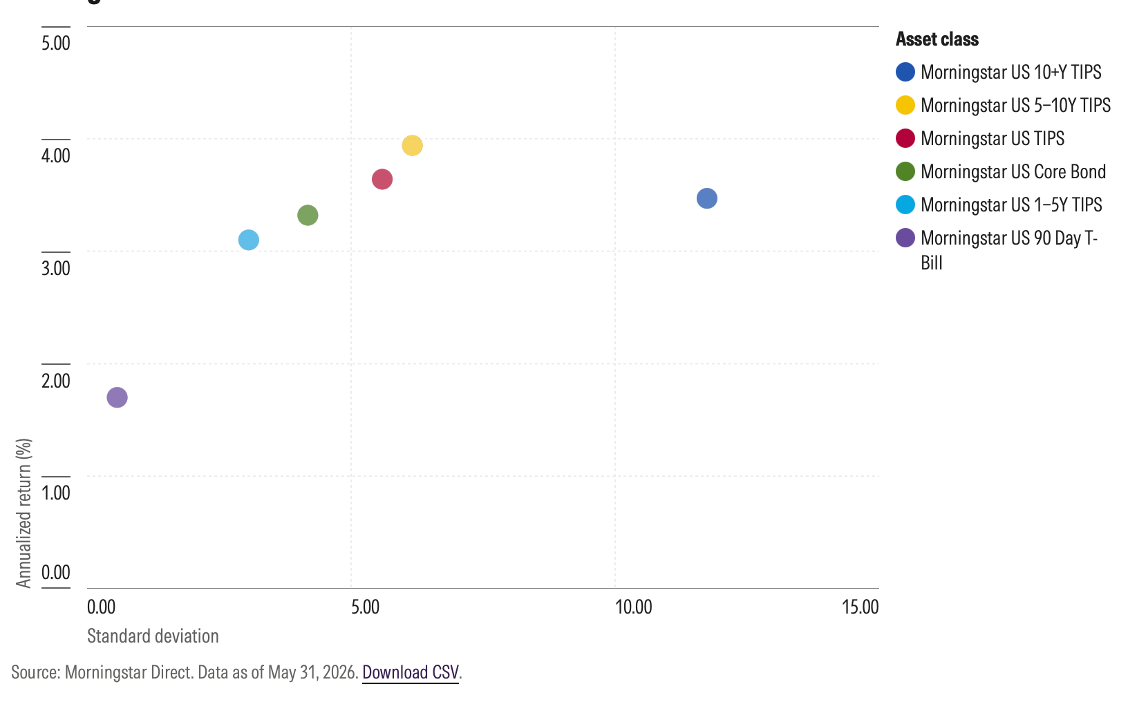
Trailing 20-Year Risk and Return: TIPS and Other Asset Classes
The principal reason for worse risk-adjusted performance in longer maturities is interest rates. TIPS prices respond immediately to changes in real yields, while inflation adjustments accrue gradually. When real yields rise sharply, price losses on long-maturity TIPS can overwhelm the inflation accrual, producing significant drawdowns during periods of interest rate spikes, as shown in the following table.
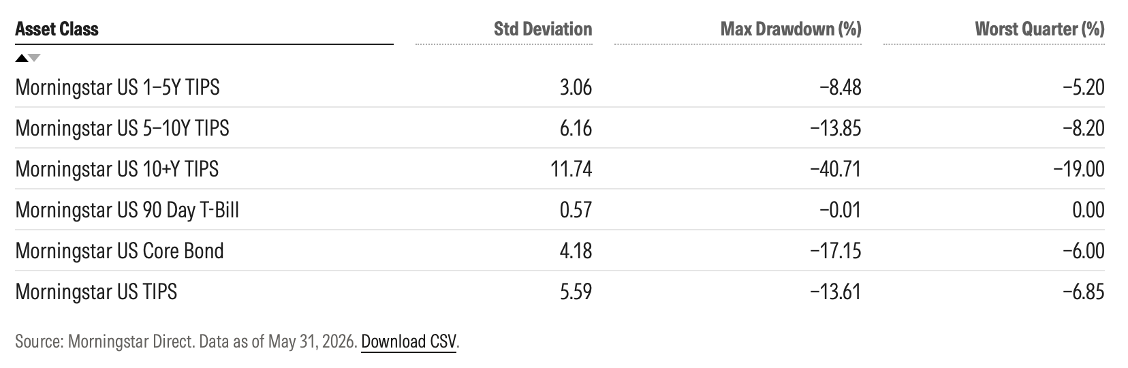
Other Risk and Drawdown Stats: Trailing 20-year Analysis
Portfolio Implications
TIPS offer diversification, with a positive but low 20-year average correlation between the Bloomberg US Treasury US TIPS TR USD and both the Morningstar Global Markets GR USD and the Morningstar US Market TR USD.
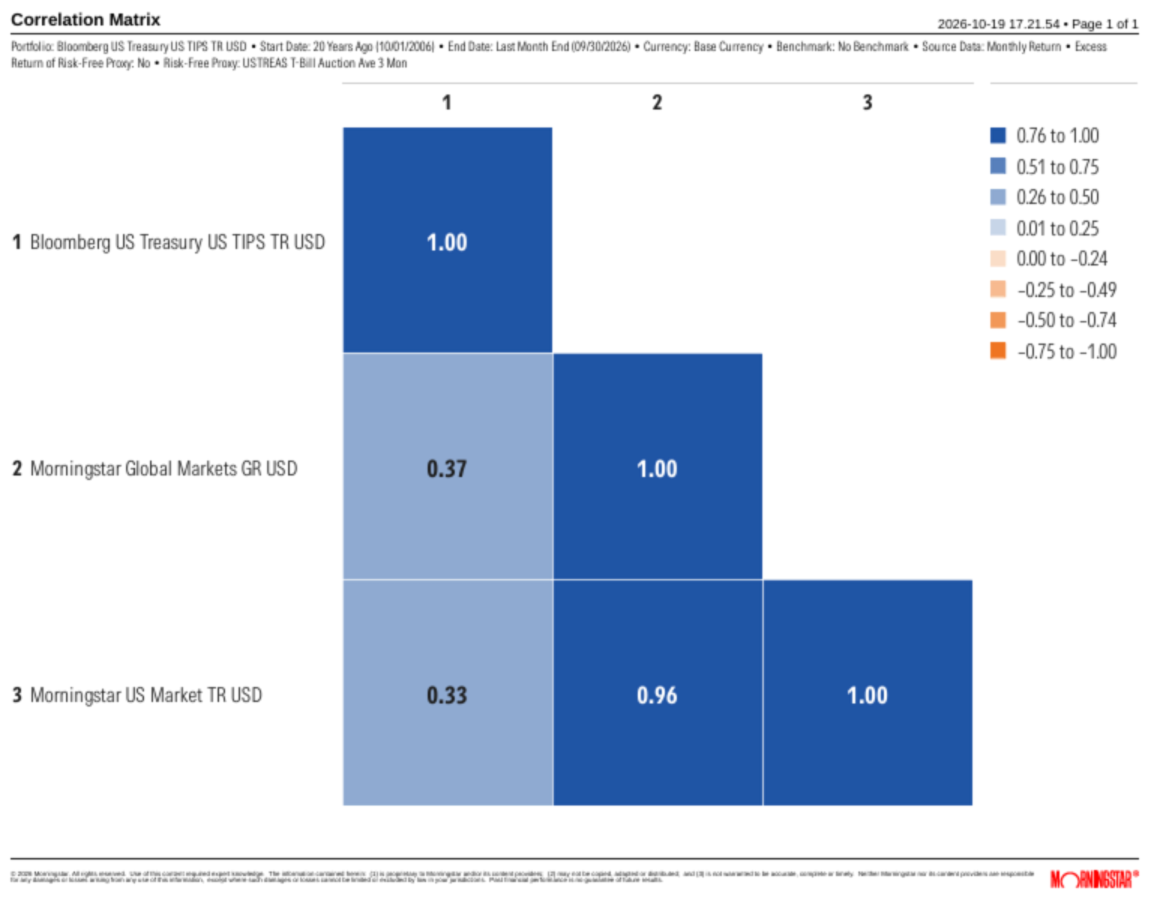
They carry negligible default risk and are generally liquid, though less so than nominal Treasuries, particularly during periods of market stress. They also hedge a specific measure of inflation, CPI-U, with roughly a two- to three-month indexation lag, and the hedge is most reliable when the bonds are held to maturity. Over shorter horizons, changes in real yields can dominate returns.
For investors in or near retirement, Morningstar suggests a reasonable allocation to TIPS is 20% to 40% of one's total fixed-income holdings, with a bias toward short- or intermediate-term maturities (Arnott 2026). In periods of crisis, TIPS may become more correlated with equities, particularly at maturities beyond 10 years. Even so, intermediate TIPS outperformed the Bloomberg US Aggregate Bond Index by 0.5% annually between 1997 and 2024 (Shahidi, n.d.).
Ultimately, TIPS carry distinctive risks, particularly sensitivity to real interest rates, while providing a valuable tool that Avrio may use when diversifying a portfolio and hedging against inflation.
Works Cited
Arnott, Amy C. and CFA. 2026. “How to Use TIPS in Your Portfolio.” Morningstar, Inc., June 8. https://www.morningstar.com/portfolios/how-use-tips-your-portfolio.
Cox, Jeff. 2026. “Consumer Prices Rose 3.7% Annually in September as Gas Prices Skyrocket.” CNBC, October 14. https://www.cnbc.com/2026/10/14/cpi-inflation-report-september-2026.html.
Shahidi, Alex. n.d. “Here’s A Tip: Don’t Overlook TIPS In Your Portfolio.” Forbes. Accessed October 15, 2026. https://www.forbes.com/councils/forbesfinancecouncil/2025/01/21/heres-a-tip-dont-overlook-tips-in-your-portfolio/.
iShares, et. al. “MECHANICS OF TIPS AND TIPS ETFs”; July 26, 2026. https://www.ishares.com/us/literature/product-brief/mechanics-of-tips-en-us-product-brief.pdf.
University of Virginia Learn about our editorial policies. n.d. “What Are Treasury Inflation-Protected Securities (TIPS)?” Investopedia. Accessed October 15, 2026. https://www.investopedia.com/terms/t/tips.asp.
PIMCO. n.d. “Understanding Treasury Inflation-Protected Securities (TIPS) | PIMCO.” Pacific Investment Management Company LLC. Accessed October 19, 2026. https://www.pimco.com/sg/en/resources/education/understanding-treasury-inflation-protected-securities.
This material is intended for educational and informational purposes only. It is not intended to provide specific advice or recommendations for any individual. Additionally, you should consult with your Financial Advisor, Tax Advisor, or Attorney on your specific situation. The views expressed in the material are that of the author and do not necessarily reflect those of any market, regulatory body, State or Federal Agency, or Association. All efforts have been made to report or share true and accurate information. However, the information may become materially outdated or otherwise rendered incorrect due to subsequent new research or other changes, without notice. The author nor the firm are able to always verify the content from third-party sources. For additional information about the firm, please visit the MAS Website at https://www.mas.gov.sg/ and the SEC Website at www.adviserinfo.sec.gov. For a copy of the firm's ADV Part 2 Brochure, please contact us at info@avriowealth.com.