
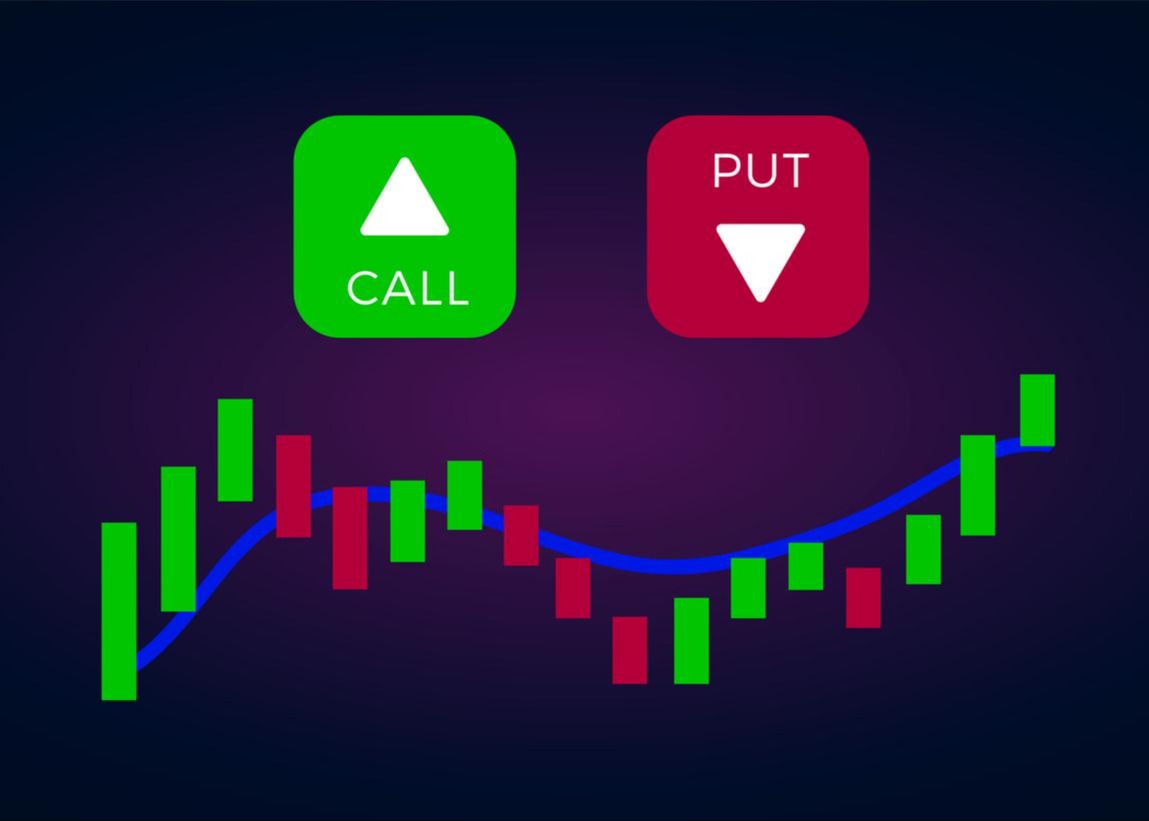
Put and Call Options
Options are contracts that give you the right to take a specific action in the future, allowing investors to hedge existing investments from potential downturns or speculate on the price movements of indexes, Exchange Traded Funds (ETFs), and/or stocks. If your aim is to generate income, speculate on future stock price movements, or hedge for potential losses, understanding options can prove useful.
Before trading options, it is required that you get approved for an options trading account by your selected brokerage. When trading options, it is important to keep in mind that the potential for high returns comes at the risk of significant losses.
Options key terms
Let’s define some key terms in options trading before diving deeper:
- American-style options—Most options contracts are American style, exercisable any time before or on the expiration date. Most stock options are American style.
- European-style options—European-style options are only exercisable at expiration. Most index options are European style.
- Premium—The cost or income of the option. If you’re buying, it’s the former; if you’re selling, it’s the latter.
- Strike price—The predetermined price at which you can buy or sell the underlying asset.
- Expiration date—The deadline by which you shall decide to exercise your option or not.
- In the money (ITM)
- A call option (defined further on) is ITM if the underlying security price is above the strike price.
- A put option (defined further on) is ITM if the underlying security price is below the strike price.
- Out of the money (OTM)
- A call option is OTM if the underlying security price is below the strike price
- A put option is OTM if the underlying security price is above the strike price.
- At the money (ATM)
- A call or put option is ATM when the strike price equals the market price of the underlying security.
If you buy the option, whether it is a put or a call, you are the one who has the right to exercise before expiration. The seller (writer) of the option, on the other hand, has the obligation to fulfill the contract if the buyer chooses to exercise. Options are typically bought and sold in lots of 100 shares of the underlying security.
Call Options
American-style call options provide the buyer with the right, but not the obligation to purchase the underlying security at the strike price on or before the expiration date. Typically, investors purchase call options when they believe the price of the underlying security will rise. If the market price goes above the strike price, the option’s value increases, enabling the investor to either sell the option for a profit or exercise it.
Example:
Imagine an investor examines the option chain and buys a call option on a stock priced at $95 for a premium of $4 per share (there are 100 shares per contract), with a strike price of $100, expiring in three months. If the stock rises to $110 before expiration, the option would be in the money. Now, the investor has two choices: buy the stock at $100, realizing a gain of $600 ($10*100 shares – $400 premium paid), or sell the option at a higher value, realizing a profit of the new, higher premium less the original premium paid. If the stock stays below the strike price at expiration, the option remains out of the money and expires worthless. The buyer’s losses are always limited to the premium paid.
The seller’s (writer) max gain is always the premium received from the buyer, but their losses can be quite large. For example, if the stock price rose to $130, they would incur a loss of $2,600: ($30*100 shares) – $400 premium received.
Put Options
American-style put options provide the buyer with the right, but not the obligation to sell the underlying security at the strike price before or on the expiration date. Oftentimes, put options are used as a hedging strategy. Investors typically buy puts when they believe the price of a security will decline or if they desire protection against potential losses in their portfolio.
Example:
Imagine an investor owns shares of a stock currently priced at $100 per share. They buy a put option for a premium of $4 per share with a strike price of $95. Suppose the stock falls to $85, the option is in the money, and the investor can sell the shares at $95, thereby mitigating losses. In this scenario, the option enables the investor to sell 100 shares for $9,100 [($95 strike price*100 shares) - $400 premium], rather than $8,500 ($85 stock price*100 shares). The option will remain out of the money and expire worthless if the stock stays above $95 per share. The buyer’s losses are limited to the premium paid.
In this scenario, the seller (writer) of the put option is limited to a maximum $400 profit ($4 premium * 100 shares), but subject to potentially massive losses. Suppose the stock drops to $0 per share and the buyer exercises their option, the seller incurs a $9,600 loss: ($100*100 shares) – $400 premium accrued.
European-style options
The fundamental difference between American-style and European-style options is when they can be exercised. American-style options may be exercised at any time up to or on the expiration date, while European-style options can only be exercised on the expiration date. Both types can be freely bought and sold in the market prior to expiration.
Risks and Considerations
While options can offer strategic advantages and flexibility, they are complex financial instruments and may not be suitable for all investors. Key risks include:
- The potential loss of the entire premium paid when buying options
- The possibility of substantial losses when selling options
- Time decay, which reduces an option’s value as expiration approaches
- Market volatility, which can significantly affect option pricing
It is important that investors fully understand how options work and how they align with their overall investment goals before incorporating them into their strategy.
Final Thoughts
Put and call options can be powerful tools for income generation, portfolio protection, and strategic investing when used properly. However, they require a disciplined and educated approach, and appropriate alignment with long-term financial goals. Please reach out to one of our wealth managers for more information on put and call options. As with all investment strategies, professional guidance and planning are essential.
This material is intended for educational and informational purposes only. It is not intended to provide specific advice or recommendations for any individual. Additionally, you should consult with your Financial Advisor, Tax Advisor, or Attorney on your specific situation. The views expressed in the material are that of the author and do not necessarily reflect those of any market, regulatory body, State or Federal Agency, or Association. All efforts have been made to report or share true and accurate information. However, the information may become materially outdated or otherwise rendered incorrect due to subsequent new research or other changes, without notice. The author nor the firm are able to always verify the content from third-party sources. For additional information about the firm, please visit the MAS Website at https://www.mas.gov.sg/ and the SEC Website at www.adviserinfo.sec.gov. For a copy of the firm's ADV Part 2 Brochure, please contact us at info@avriowealth.com.